

The Carbon Numbers Behind Your Coffee Bag and Why They Matter for Sales
Coffee's environmental story gets told mostly in farming statistics, water use numbers, and deforestation reports. Those are real problems, and they deserve attention. But somewhere in that bigger conversation, a smaller number keeps getting mentioned without ever getting its full story: packaging accounts for roughly 3% of coffee's total lifecycle carbon footprint. That sounds like a footnote. In some ways it is. But in 2026, that 3% has a direct connection to how much coffee you sell, how loyal your customers are, and how your brand stands apart from the one sitting next to it on the shelf.Where Coffee's Carbon Actually Comes From
To understand why 3% matters, you first need to see the full picture. Coffee's carbon footprint spans every stage of its journey, from the moment a seedling goes into the ground to the morning your customer runs their first brew. Farming is by far the biggest contributor. Growing, harvesting, drying, and processing coffee beans generates the vast majority of the crop's total emissions, somewhere in the range of 85% across most lifecycle studies. The main culprits are land use change and deforestation, nitrogen-based fertilizer use, and the energy required for wet mill processing. This is where most of coffee's climate story lives, and roasters have almost no direct control over it. After the farm, emissions break down roughly like this across the supply chain:- Roasting accounts for about 4 to 6% of total lifecycle emissions
- Distribution and shipping account for around 5%
- Packaging sits at approximately 3%
- Consumer brewing at home makes up the remainder
The 3% Your Brand Can Actually Control
Roasters cannot change how a farm in Central America uses fertilizer. They cannot reroute cargo ships or redesign how a home brewer heats water. What they can do is choose what their bag is made of, and what happens to it after the coffee is gone. That choice matters far more than the percentage suggests. Packaging is not just a material decision. It is a brand statement. The bag is the first physical thing a customer holds. It is what sits on their counter for two to three weeks. It is what ends up in their trash, their recycling bin, or, with the right program in place, an industrial composting facility or a second life in construction. When a customer reads a line on a bag that says their packaging gets repurposed into building materials, they carry that story with them. Brands that treat the packaging footprint as an afterthought are missing the most visible and controllable part of their environmental impact. Brands that lean into it are finding a measurable advantage, not just in feel-good marketing, but in actual sales numbers.Why a Small Number Has a Big Effect on Sales
Consumer behavior data from 2025 and 2026 tells a consistent story. Sustainable packaging has moved from a nice-to-have feature to a purchase driver. 90% of consumers say they are more likely to buy from a brand that uses eco-friendly packaging. 74% are willing to pay more for a product that comes in sustainable packaging, and early market data shows that premium can run anywhere from 10 to 15% above a standard retail price.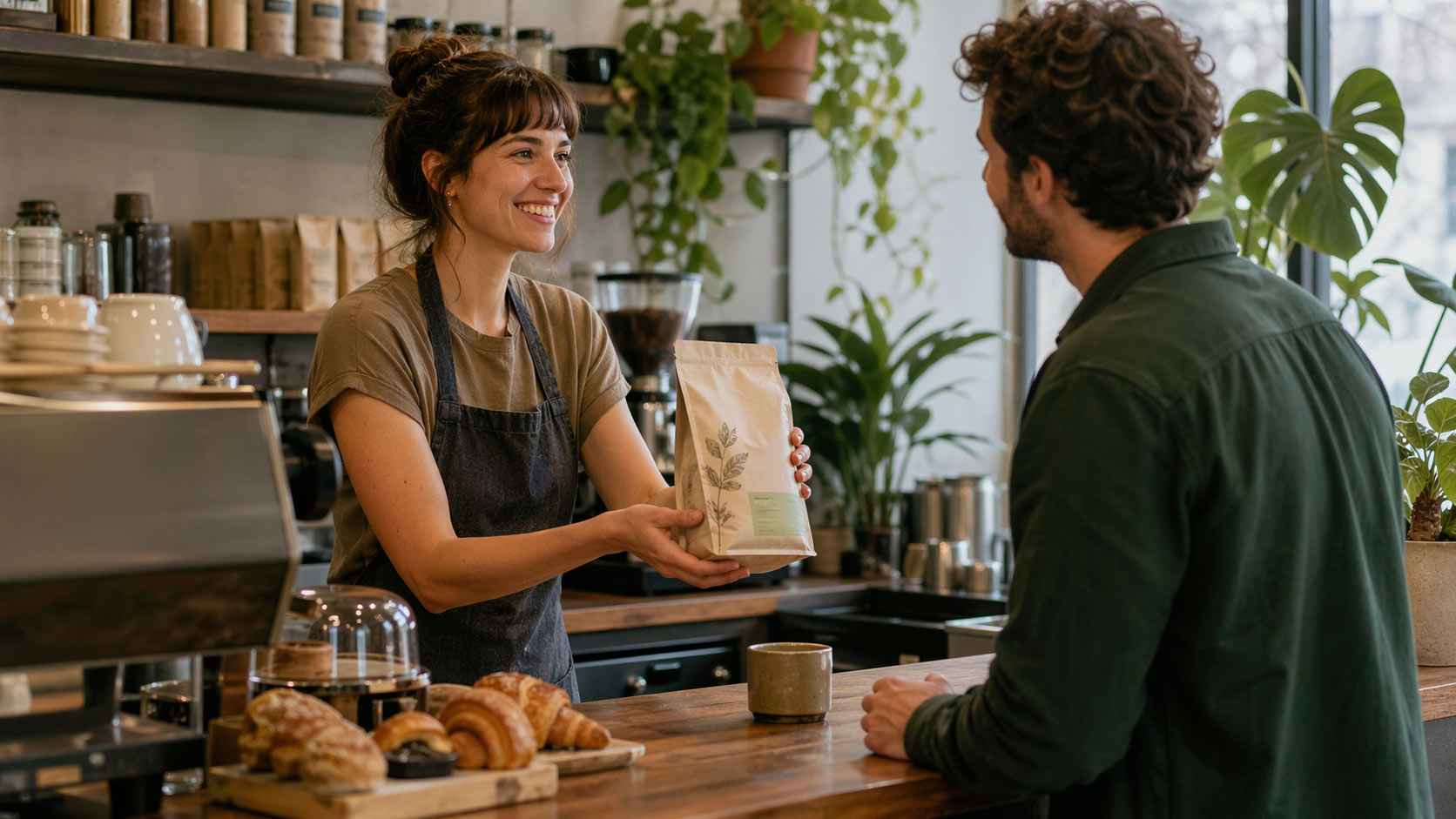 More than one in three consumers has switched to a competing brand specifically because that brand offered more sustainable packaging. Nearly 7 in 10 consumers now say they expect the brands they support to offer sustainable packaging as a baseline. That expectation is not coming from a niche group of shoppers. It is coming from the same everyday coffee buyers who are already in your store or visiting your website.
For coffee brands, those numbers translate directly to shelf performance, repeat purchases, and the kind of customer loyalty that does not require constant discounts to maintain. The 3% slice of your carbon footprint is the part your customers can see and hold in their hands, which makes it the most powerful sustainability story your brand can tell.
More than one in three consumers has switched to a competing brand specifically because that brand offered more sustainable packaging. Nearly 7 in 10 consumers now say they expect the brands they support to offer sustainable packaging as a baseline. That expectation is not coming from a niche group of shoppers. It is coming from the same everyday coffee buyers who are already in your store or visiting your website.
For coffee brands, those numbers translate directly to shelf performance, repeat purchases, and the kind of customer loyalty that does not require constant discounts to maintain. The 3% slice of your carbon footprint is the part your customers can see and hold in their hands, which makes it the most powerful sustainability story your brand can tell.
What the Right Packaging Does for Your Brand
Sustainable packaging does more than signal good intentions. It opens up specific marketing conversations that conventional bags simply cannot support. A roaster with certifiable sustainable packaging can make precise, backed claims instead of vague language. Phrases like "our bags are repurposed into drainage systems" or "this bag is certified industrial compostable by DIN Certco" give customers something real and specific to connect with. That specificity builds trust, and trust builds sales in a way that general eco-friendly messaging rarely does on its own. Roasters who communicate their packaging sustainability story clearly tend to see stronger engagement on social media, higher repeat purchase rates, and the kind of word-of-mouth referrals that paid advertising cannot buy. Customers who care about environmental impact also talk about it, and they tend to share the brands that back up their claims with something concrete. Earth Month each April creates a natural opportunity to spotlight these efforts, and the roasters who already have a genuine story to tell during that window consistently outperform those who are scrambling to say something without much behind it.Two Solutions That Let Roasters Act on That 3%
Addressing your packaging footprint does not require a total overhaul of your operations or a jump to unfamiliar suppliers. Savor Brands has two programs built specifically to give roasters a concrete, verifiable path to reducing their packaging impact without disrupting how they already work. The first is the R+R Program, which stands for Repurpose and Reprocess. This program is designed for roasters who are already using standard high-barrier multilayer film bags, the type most specialty coffee brands run today. When your bags come back empty, instead of heading to a landfill, they get collected in an R+R box that Savor Brands ships directly to you. Once the box is full, you use the provided shipping label to send it back. From there, the collected film goes to upcycling partners. ByFusion converts the packaging into durable building blocks used in construction projects. HydroBlox turns it into drainage systems installed in landscaping and commercial construction applications. Your bags get a genuine second life in the built environment. When the cycle is complete, roasters receive a digital certificate confirming that their packaging was processed through the program. You can learn more and enroll at rplusrprogram.com. The second solution is Compost+ packaging. These are 100% industrial compostable coffee bags made from a certified laminate film and premium compostable kraft paper. The bags carry DIN Certco certification, one of the most respected industrial compostability standards available. They use compostable, toxin-free inks throughout the printing process, which means the sustainability runs all the way through the bag and not just the outer material. Compost+ bags still deliver the barrier protection your coffee needs to stay fresh from the roastery to the customer's counter. They are produced using digital printing technology, which keeps minimum order quantities low and makes them accessible for roasters at every stage of growth, from small-batch to high-volume production. Both options move the needle on that 3% in a way that is documented, communicable, and genuinely meaningful to the customers who are paying attention.The Business Case for Getting This Right in 2026
Coffee brands that ignored sustainability messaging five years ago had time to catch up. That window is closing. State-level packaging regulations are expanding across the United States, and consumer expectations have shifted from optional to expected. The brands building sustainable packaging habits now are the ones that will be positioned well as those requirements tighten. The good news is that coffee is a category built for authentic storytelling. Roasters who source thoughtfully, roast carefully, and then package with purpose have a complete chain of decisions worth sharing. Packaging is the last link in that chain before the coffee reaches a home kitchen, and it is the one link your customer holds in their hands every single morning. When that bag tells a true, specific sustainability story, it turns a routine purchase into a brand relationship. Fixing your 3% will not solve every climate problem in the supply chain. But it will grow your loyal customer base, add a clear differentiator to your shelf presence, and give your brand a story worth sharing in a market that has more coffee choices than ever before.Small Number, Real Impact
The carbon math behind a coffee bag is straightforward once you lay it out. Most of the footprint lives on the farm, where roasters have limited reach. The packaging piece is small by comparison. But it belongs entirely to your brand, it is the part your customers interact with every day, and in 2026, it is one of the clearest signals a roaster can send about the kind of company they are building. Savor Brands built the R+R Program and the Compost+ line specifically for this reason: to give roasters a genuine, certifiable path to addressing their packaging footprint without making sustainability feel like an expensive or complicated addition to the business. If you want to talk through which option fits your roastery, the Savor Brands team is ready to help you take the next step.Why Us?
 3x SCA Best New Product Award Winner
Industrial Compostable Packaging
Your Very Own White Label Mobile App
Pono Collective: Providing Coffee Education
Lower MOQs With Our Digital Print Process
Setting Trends While Elevating Your Brand
Contact Our Team!
Other Blogs of Interest


Why Coffee Packaging’s 3% Carbon Footprint Still Matters
Coffee is one of the world’s favorite beverages, enjoyed by millions daily. However, it often comes with a side of guilt due to its environmental implications. From cultivation to delivery, coffee's supply chain significantly contributes to global emissions. Surprisingly, coffee packaging accounts for ...


Earth Month Is the Perfect Time to Market Your Sustainable Coffee Packaging
April is Earth Month, and your customers are already paying closer attention to the brands they support. They are reading labels, asking where things come from, and choosing businesses that take their environmental impact seriously. If your roastery uses sustainable coffee packaging or participates in ...


The Carbon Footprint Case for Digital Coffee Bag Printing in 2026
Your Coffee Bag Can Do More Than Look Good. It Can Actually Help the Planet Digital printing is one of those choices. And not in a vague, feel-good way. There are specific, measurable reasons why switching to digital packaging production reduces your coffee brand's carbon footprint. This post lays ...


Compost+ vs. Traditional Coffee Bags: The Side-by-Side Comparison Every Roaster Needs
Compost+ vs. Traditional Coffee Bags: The Side-by-Side Comparison Every Roaster Needs At some point, every roaster asks the same question: Is sustainable packaging worth it? There is no shortage of opinions, but what most roasters actually need is a straightforward, side-by-side look at what change...