

No Form-Fill-Seal Machine? How Coffee Roasters Still Get the Benefits of Roll Stock Film
The economics of roll stock film are hard to argue with at high volume. The cost per bag drops, the print quality from rotogravure is among the sharpest available in coffee packaging, and the consistency across a production run is difficult to match with pre-made pouches. The barrier between most growing roasters and roll stock is not the price of the film. It is the form-fill-seal machine required to convert that film into a finished bag, and those machines start in the low five figures even on the used equipment market. But owning the machine is not the only path to roll stock. There is a practical alternative that a significant portion of mid-volume roasters already use, and it is worth understanding before deciding that roll stock is out of reach for your operation.What Roll Stock Film Actually Is
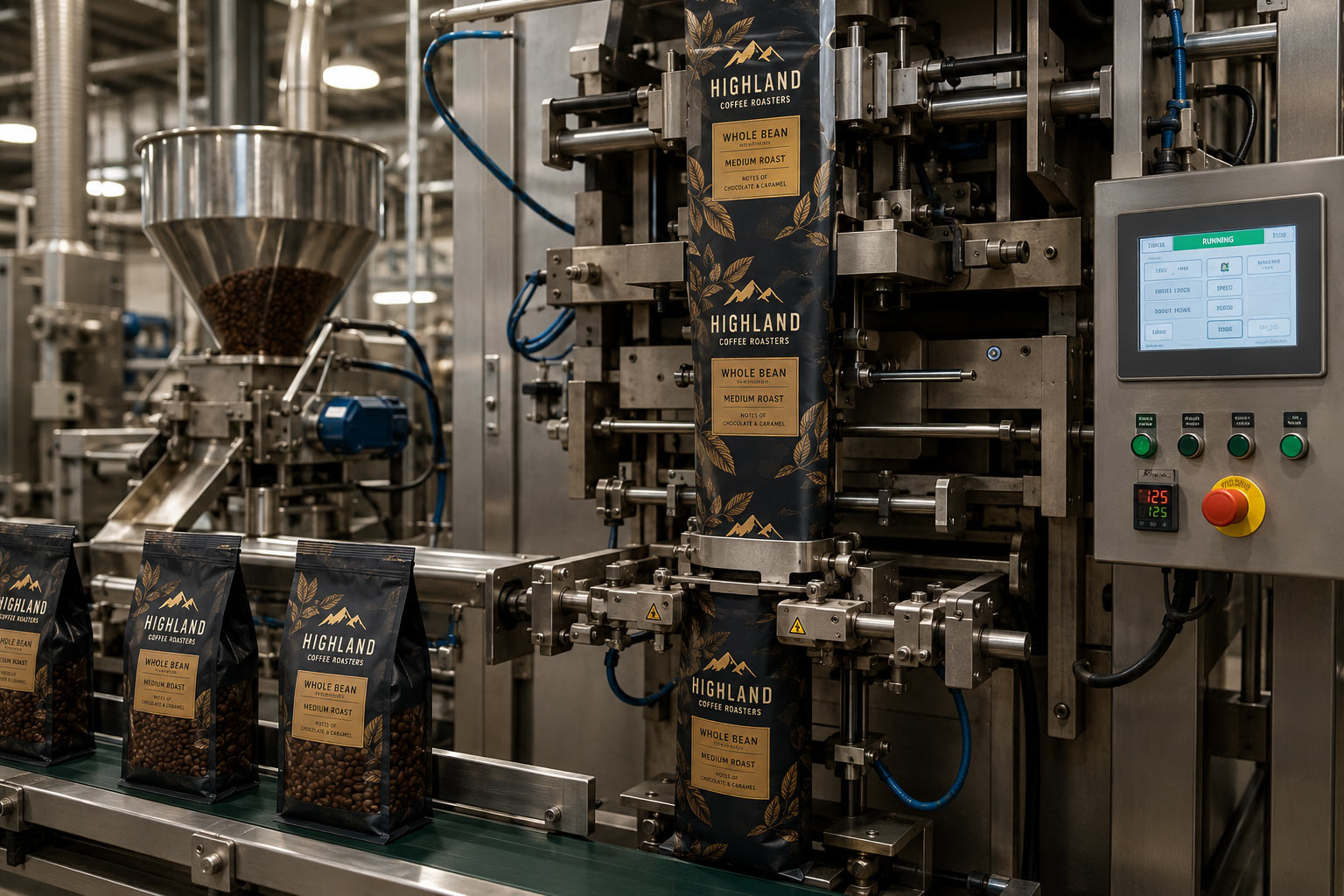
Roll stock film is a continuous sheet of packaging material, printed and wound onto a large spool. It is not a finished bag. To become a bag, it has to run through a form-fill-seal machine, which takes the flat film, shapes it into a pouch, fills it with product, seals it closed, and delivers a finished, ready-to-sell unit. Savor Brands prints and supplies roll stock coffee packaging film. The printing, the laminate structure, the barrier layers, the artwork, and the degassing valve placement are all handled on the Savor Brands side. The forming, filling, and sealing step happens at whichever facility operates the form-fill-seal machine, whether that is the roaster's own production floor or a co-packer's facility.- Rotogravure printing on roll stock produces precise, high-color-volume graphics that hold consistency across very large runs
- Film is sold by the roll and priced per unit, with costs dropping meaningfully as volume increases
- The film can ship directly to a co-packer, keeping the two supply relationships separate and flexible
The Machine Barrier Is Real
A vertical form-fill-seal machine is the standard piece of equipment for converting roll stock film into finished coffee bags. New machines start around $30,000 to $40,000 for basic configurations and climb well past $100,000 for faster, more automated lines. Used machines are widely available and can bring that entry cost down significantly, but used equipment still means maintenance costs, downtime risk, and staff who understand how to operate and calibrate the line correctly. For a roaster packaging at high volume, the investment makes financial sense. The per-unit savings from roll stock film compared to pre-made bags can recover the cost of a machine in a reasonable timeframe when the production numbers are there. For a roaster growing toward that volume threshold, the capital commitment is a real obstacle. The math does not yet justify the machine, but the cost pressure from pre-made bags is already present. This is exactly the gap the co-packer model was built to bridge.How the Co-Packer Route Works
A co-packer is a third-party production facility that already owns and operates form-fill-seal equipment. Instead of buying a machine, you contract with a co-packer who runs your roll stock film through their line. You order the custom-printed film from Savor Brands, and that film ships to the co-packer. The co-packer fills the bags with your coffee, seals them, handles nitrogen flushing and valve insertion, applies date codes, and delivers finished, sealed product ready for distribution. This model separates the film supply relationship from the bag production relationship entirely. Savor Brands is your print and materials partner. The co-packer is your production partner. You manage both, but the two work independently. The finished result is a bag that looks and performs identically to what you would produce on your own line, because the film is the same material either way. The co-packer charges a per-unit service fee for machine time and labor. That fee reduces the per-unit savings compared to running your own equipment, but it eliminates the capital investment and the operational burden completely. For a roaster not yet at the volume where a machine pays off, the co-packer model captures the majority of the cost and quality benefit while the business continues to grow.- Co-packers handle filling, nitrogen flushing, heat sealing, seal integrity checks, date coding, and case packing
- You supply the coffee and the film; the co-packer supplies the equipment and the labor
- Finished product ships from the co-packer to your warehouse or fulfillment center
What to Look for in a Coffee Co-Packer
Not every co-packer is set up for coffee specifically, and that distinction matters. Coffee filling requires nitrogen flushing to displace oxygen before sealing, one-way degassing valves for whole and ground bean products, precise fill weight control, and seal integrity testing that holds up against the internal gas pressure a freshly roasted bag produces over time. A general food co-packer without coffee experience may lack the equipment or the protocol for these steps. When evaluating a co-packing partner, confirm that their equipment is compatible with your specific film structure before committing to a full order. Different laminate combinations, particularly those with metallic barrier layers, behave differently on different form-fill-seal machines. A pilot run on a small quantity of film is the most reliable way to confirm compatibility and catch any issues before they scale up. Lead time is also a genuine consideration. Co-packers with coffee experience are in demand, particularly during Q3 and Q4 when holiday packaging volume spikes across the industry. Most require booking in advance and set minimum quantities per run based on the setup time involved in changing over their line to a new film specification.- Look for co-packers who work regularly with coffee or comparable high-gas products, not general dry goods operations
- Ask specifically about nitrogen flushing capability and how they handle degassing valve insertion during the fill process
- Request references from other coffee roaster clients; a co-packer with real coffee experience will have them readily available
Planning Your Film Order with Savor Brands
When you order custom coffee bags in roll stock film format from Savor Brands, you are ordering a custom-printed material. The film order involves selecting your bag structure and dimensions, confirming your laminate and barrier requirements, providing print-ready artwork, and placing the order at the required minimum quantity. Roll stock minimums are typically higher than pre-made bag minimums because the film is produced on a press that requires a setup investment recovered over a longer run. Confirming the minimum with Savor Brands before you lock in your co-packer schedule is important, because the co-packer will need the film quantity to plan their production run accordingly. Once the film ships, coordinate with your co-packer on receiving logistics. Film rolls are large and require proper storage conditions: cool, dry, away from direct light, and stored horizontally on a core to prevent distortion. A co-packer experienced with roll stock will have appropriate storage, but it is worth confirming before the rolls arrive.Is This Setup Right for Your Operation?
The roll stock film and co-packer model fits best for roasters producing roughly 10,000 to 50,000 bags per year on a core SKU. If you want the per-unit cost advantage and print quality of rotogravure printing but are not at the volume where owning a machine pays off within a reasonable timeline, the co-packer route fills that window. It also works well as a bridge strategy. You use the co-packer route to grow your volume, track your per-unit costs, and build the data that makes the case for in-house equipment when the numbers justify it. Many mid-size roasters follow exactly this path, and the transition from co-packer to in-house production is smoother because they already understand roll stock film and its requirements before making the machine investment. If you are currently using digital packaging on pre-made pouches and watching your cost per unit climb with volume, the roll stock film plus co-packer model is worth a serious look before assuming that owning a machine is the prerequisite. The print quality gap between rotogravure film and digital on pre-made pouches is meaningful at quantities above 10,000 units, and the co-packer route makes that quality accessible without the capital requirement.- Confirm your co-packer's minimum run quantity before placing your film order with Savor Brands; the two numbers need to align
- Build in a pilot run before committing to a large film order; a short test confirms equipment compatibility and lets you evaluate finished bag quality in hand
- Plan your inventory cycle carefully; roll stock at co-packing scale typically allows less flexibility on short-notice reorders than pre-made bags
Two Partners, One Finished Bag
Roll stock film does not require you to own equipment. It requires understanding where the equipment step lives in your supply chain and building the right partner relationship to cover it. For roasters who are not yet at the scale where a form-fill-seal machine makes financial sense, the co-packer model is a direct path to the bag quality and per-unit economics that roll stock offers, without waiting until the volume justifies the capital. Savor Brands handles the film: the printing, the structure, the barrier, and the artwork. Your co-packer handles the forming, filling, and sealing. Between the two, you get a finished bag that performs and looks like a large-brand product, built entirely around your coffee and your brand, on a timeline that matches where your business actually is today.Why Us?
 3x SCA Best New Product Award Winner
Industrial Compostable Packaging
Your Very Own White Label Mobile App
Pono Collective: Providing Coffee Education
Lower MOQs With Our Digital Print Process
Setting Trends While Elevating Your Brand
Contact Our Team!
Other Blogs of Interest


Roll Stock Coffee Packaging Explained: What It Is and When to Use It
When Coffee Roasters Should Switch to Roll Stock Packaging Most coffee roasters start simple. A few hundred bags ordered at a time, filled by hand or with a basic tabletop sealer, sealed up and shipped out. That system works. For a while. Then the orders pick up. You are sealing bags for two or thr...

Co-Packing vs Private Label Coffee Bags
How to Choose Co-Packing vs Private Label New coffee brands often mix up co-packing and private label. The terms sound similar, but they serve very different goals. Co-packing supports your own coffee with outsourced production steps. Private label sells a finished product that a supplier already c...


Launch Faster With Co-Packaging Coffee Bags
Print With Confidence, Pack For Growth Most roasters can’t afford the equipment for filling, sealing, nitrogen flushing, weighing, labeling, and quality testing. A co-packer already has this setup, so the roaster avoids huge upfront investment. Co-Packaging Coffee Bags gives a young brand professio...


Custom Coffee Bags Explained: Stand Up Pouches
Stand Up Pouches have been a favorite for roasters and customers for many years. Its design to stand upright on shelves offers the perfect balance of practicality and presentation for many businesses. Why Choose Stand-Up Pouches? This bag style is known for its "more bang for its buck" due to it...